
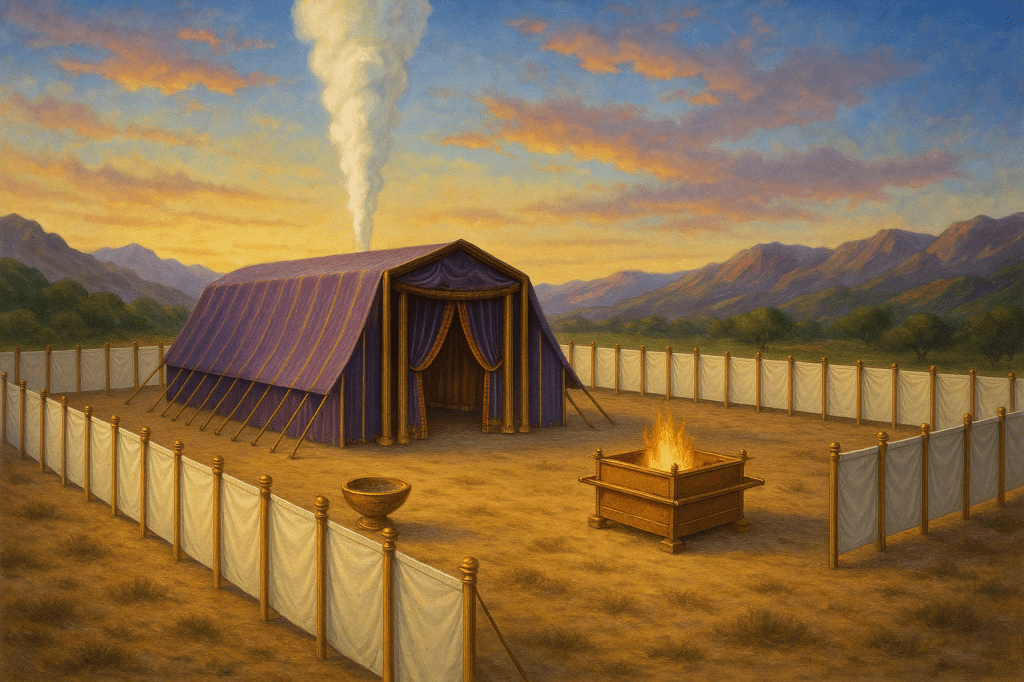
God has always sought to make his presence known to us and reveal to us his glory. In Exodus 25:8-9 God says to Moses, “Then have them make a sanctuary for me, and I will dwell among them. Make this tabernacle and all its furnishing exactly like the pattern I will show you” (NIV). Moses indeed built this tabernacle (which looks like a portable tent), and it became known as the house of the LORD, a place where God dwelt and all those who sought him could find him. When the children of Israel ended their exodus and settled into the promised land, the tabernacle was replaced by a temple, a more solid, permanent structure.
However, fast forwarding in time a bit, in Ezekiel 10:18 it states “Then the glory of the LORD departed from over the threshold of the temple and stopped above the cherubim” (NIV). Why did God’s glory leave the temple? What happened?
In the previous chapter, God tells Ezekiel “The sin of the people of Israel and Judah is exceedingly great; the land is full of bloodshed and the city is full of injustice” (Ezekiel 9:9 NIV). To be specific, men all over the land of Israel were worshiping false idols, and even doing it in the Temple. Ezekiel says, “So I went in and looked, and I saw portrayed all over the walls all kinds of crawling things and unclean animals and all the idols of Israel” (Ezekiel 8:10 NIV). He says further, “He [God] then brought me into the inner court of the house of the LORD, and there at the entrance to the temple, between the portico and the altar, were about twenty-five men. With their backs toward the temple of the LORD and their faces toward the east, they were bowing down to the sun in the east.” (Ezekiel 8:16 NIV).
To determine why God withdrew his presence from the physical temple the Israelites built, we have to know a thing or two about his true nature or character. In Isaiah 43:15, God says “I am the LORD, your Holy One, Israel’s Creator, your King” (NIV). In this verse, God tells us four things about his character, but I primarily want to focus on his claim to being the “Holy One.” What does this mean? Writer Bethany Verrett in her article titled “What Does It Mean to Be Holy?” stated that “Holiness is the state of perfection, being fully sanctified, and set apart from sin.” So, if God in his nature is holy, otherwise meaning fully perfect and fully set apart from sin, then would it be within his capability to dwell in a house of sin? Think of it this way, if you are by nature an oxygen-breather, would it be within your capability to live in a house filled with only carbon dioxide?
Just as we cannot contradict our true and unfailing nature, neither can God. God cannot sin nor can he call a house where sin is present his home. The Israelites during the time of Ezekiel desecrated the temple with their sins and idolatry and forced God to flee.
This all sounds like pretty hopeless and depressing news, but my God is not a God of sad endings. In fact, in Ezekiel 43:4-5 it states, “The glory of the LORD entered the temple through the gate facing east. Then the Spirit lifted me up and brought me into the inner court, and the glory of the LORD filled the temple” (NIV). After a short period of desolation, God returned back to the temple to restore his covenant to the Israelites and once again give them a place to know and to worship the LORD. What an amazing grace!
Or, so we thought. The Israelites continued going to the temple to worship the LORD for generations, but this was not beneficial or convenient for all. In John chapter 4, Jesus encountered a Samaritan woman who said to him, “Sir, I can see that you are a prophet. Our ancestors worshiped on this mountain, but you Jews claim that the place where we must worship is in Jerusalem.” In essence, this Samaritan woman was expressing a sentiment or feeling of disconnect from God because she felt that she had no place to go to worship. Jesus replied to her, “Woman, believe me, a time is coming when you will worship the Father neither on this mountain nor in Jerusalem. You Samaritans worship what you do not know; we worship what we do know, for salvation is from the Jews. Yet a time is coming and has now come when the true worshipers will worship the Father in the Spirit and in truth, for they are the kind of worshipers the Father seeks. God is spirit, and his worshipers must worship in the Spirit and truth” (John 4:19-24 NIV). What Jesus is saying here is 1) that the God of the Jews is the one true God, and 2) the way in which people worship Him will no longer be confined to a particular building or structure (in this case, he was referring to the temple in Jerusalem). So, how will the people worship God? Jesus tells us, in Spirit and in truth.
Paul says in 1 Corinthians 3:16, “Don’t you know that you yourselves are God’s temple and that God’s spirit dwells in your midst?” (NIV). Jesus doesn’t give us the exact coordinates of where to worship because he doesn’t need to; we can worship in Spirit and in truth at the temple of our very own bodies. How generous is He!
You may be wondering, how is it possible for God to make his temple and dwell within us if we are sinners? We defile our bodies and contradict God’s holiness all the time, so how can he possibly make his home in our hearts? Well, he can’t. No, well, not unless, of course, we accept his only son Jesus Christ as our LORD and savior! Accepting Jesus Christ as our savior is truly the only way the presence of God can dwell within our hearts because Jesus Christ has already paid the penalty for our sins. Remember when I said God cannot contradict his nature? Well, when he dwells in a believer of Christ, they have already been made holy through their faith. Paul says in Romans 5:9 that we have been justified by the blood of the risen Christ.
Even though God makes the promise that he will dwell amongst us believers, what happens when we do inevitably sin? In 1 Corinthians 3:17 Paul says “If anyone destroys God’s temple, God will destroy that person; for God’s temple is sacred, and you together are that temple” (NIV). We are justified through our faith in Christ, yes, but that does not make us impervious to the effects of sin. Paul clarifies in Romans 6:1-2 that we should “by no means” go on sinning because we have already died to our sins. Further, God says in Leviticus 11:44 “I am the LORD your God; consecrate yourselves and be holy, because I am holy” (NIV). Our call to holiness and righteousness does not end just because we have put our faith in Jesus Christ. We have to understand that although God loves us and wants to dwell within us, he will not participate in any act of sin. So, when we knowingly and consciously sin, we are no better than the idolaters in the book of Ezekiel that worshipped false idols in the temple and forced the LORD to flee.
When we sin, the LORD cannot be with us. He cannot guide our steps, formulate our thoughts, or soften our hearts in the direction towards sin. When we make a conscious effort to sin, we are asking the LORD to leave us. We send him away to leave us to our vice. And that sense of inconsolable emptiness we inevitably feel after indulging a particular vice is what we’re left with after pushing God away.
God wants to be there for us and comfort us, even in our moments of weakness and painful temptation. Psalms 23:4 says, “Even though I walk through the darkest valley, I will fear no evil, for you are with me; your rod and your staff, they comfort me” (NIV). When you feel tempted to sin, allow the presence of God within you to make himself known. Allow yourself to experience the fear of what it would be like for you to forsake God in your moment of sin. Allow yourself to consider what true loneliness and separation from God and the Spirit would feel like after you’ve sinned. Above all else, allow God to comfort you. Take up his rod and staff which will guide, protect, and discipline you through every walk of life.
 Finding Your Faith